
Leveraging AI for Your 2026 Performance Review: Strategies to Secure Promotions and Raises

What You’ll Gain From This
By integrating AI into your performance review strategy, you will transform how you manage your career trajectory.
- Data-Backed Confidence: You will enter negotiations armed with objective data, completely removing imposter syndrome from the equation.
- Strategic Alignment: You will master the ability to map your daily tasks directly to high-level company revenue and growth goals.
- Higher Compensation: By utilizing AI for precise market research and negotiation roleplay, you will maximize your chances of securing a significant raise.
- Future-Proofed Value: You will clearly signal to your organization that you are an adaptable, forward-thinking leader ready for the challenges of an AI-driven future.
The modern workplace has undergone a seismic shift. In 2026, relying solely on your manager’s memory to secure a promotion or a raise is a strategy destined to fail. Performance evaluations are no longer based on subjective feelings and end-of-year scrambles.
Instead, human resources departments have heavily integrated continuous, AI-driven performance management tools. These systems track metrics, analyze project outcomes, and benchmark skills across the entire organization [Source: Forbes HR Trends, 2026]. If you are still bringing a traditional, bulleted "brag sheet" to your review, you are bringing a knife to a laser fight.
This creates a complicated scenario for mid-career professionals. Your evaluators have data-driven insights into your performance, which means you need to advocate for yourself using an equally sophisticated, data-backed approach. So, how do you level the playing field and ensure your contributions are recognized and rewarded?
The answer lies in adopting AI-enabled guidance. By utilizing AI platforms—like the upskilling and career-mapping tools we develop at Exibell—you can build a bulletproof, data-centric case for your next big career leap.
The 2026 Landscape: How AI is Reshaping Performance Reviews
Artificial intelligence is rapidly changing how performance is tracked, evaluated, and communicated within companies. Organizations are increasingly using AI to analyze large datasets, map out internal talent networks, and identify who is ready for leadership.
For you, this means the traditional annual review has transformed into an ongoing data conversation. Your employer expects you to demonstrate not just competence in your role, but high-level AI literacy—showing exactly how you utilize technology to maximize your output.

To successfully navigate this new terrain, you need to use AI tools proactively. You must seamlessly translate your daily efforts into the objective, data-backed language that modern HR platforms—and modern managers—understand [Source: IAPP HR Analytics, 2026].
Transforming Core Skills into AI-Enabled Actions
To position yourself as an indispensable asset, you must prove that your skillset has evolved. Here is how to translate traditional skill categories into powerful, AI-enabled actions for your review.
1. AI Literacy: From Buzzword to Business Value
Don't just tell your manager you "know" AI. Use AI to document how you've optimized workflows.
- Action: Utilize prompt-engineering to aggregate your weekly project outcomes into a quarterly impact report.
- Action: Show how you implemented generative AI to reduce a specific task's completion time by 30%, saving the company tangible resource hours.
2. Professional Skills: Data-Driven Self-Assessment
Subjective self-assessments are obsolete. AI can help you quantify your professional milestones.
- Action: Feed your project briefs and outcomes into an AI analyzer to extract measurable KPIs you might have missed.
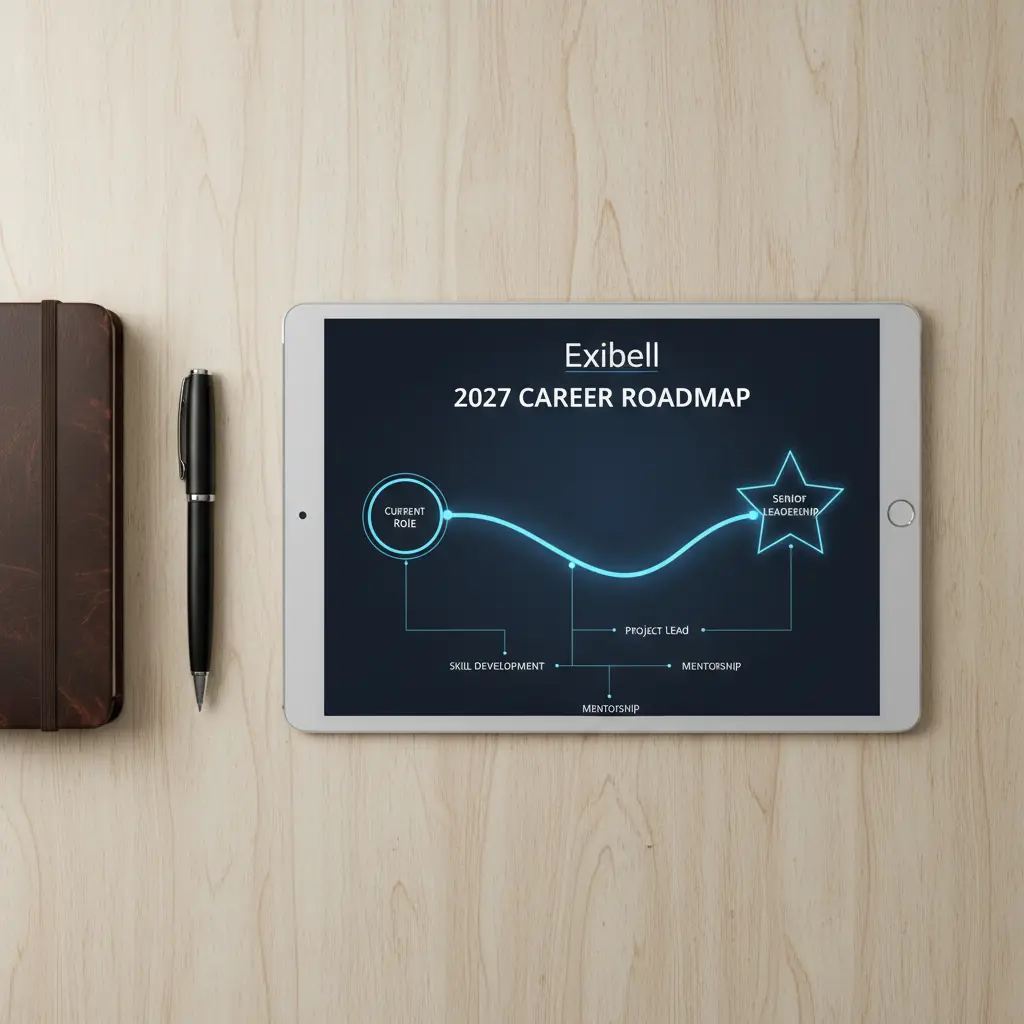
- Action: Use an AI-driven career roadmap—like those provided by Exibell—to visually demonstrate how your newly acquired skills align with the company’s strategic goals for 2027.
3. Soft Skills: Enhancing EQ with AI Feedback
Communication and empathy are more crucial than ever, but AI can refine how you present them.
- Action: Run your self-assessment drafts through an AI tone-checker to ensure you sound confident, collaborative, and authoritative, rather than defensive or demanding.
- Action: Prepare for the actual conversation using AI-powered mock interviews to practice your salary negotiation phrasing, refining your emotional intelligence in real-time.

How-To: Build Your AI-Powered Performance Case
Preparing for a performance review used to take weeks of digging through old emails. Today, a strategic, AI-enabled workflow can synthesize your year in a fraction of the time.
Follow these steps to build an undeniable case for your promotion.
Step 1: Automate Your Achievement Tracking
Stop relying on memory. Set up an automated workflow where you log your weekly wins into a centralized document. At the end of the year, feed this document into a Large Language Model (LLM) to categorize your achievements by company OKRs (Objectives and Key Results).
Step 2: Craft Impact Statements with AI
Prompt an AI assistant to convert your basic task list into the "Situation-Task-Action-Result" (STAR) format. For example, instead of saying "Managed the marketing campaign," AI can help you formulate: "Leveraged predictive analytics to optimize campaign targeting, resulting in a 22% increase in Q3 conversions."
Step 3: Conduct AI-Driven Market Salary Research
When asking for a raise, you need accurate, hyper-current data. Use specialized AI compensation tools to analyze real-time market rates for your specific role, location, and new AI-enhanced skill set [Source: Chatvisor AI Trends, 2025].
Step 4: Identify Upskilling Opportunities
Employers want to promote forward-thinkers. Run your current job description against your desired senior role using an AI skills gap analyzer. Present your manager with a proactive, Exibell-generated learning roadmap, showing exactly how you plan to bridge those gaps in the next six months.
The Contrarian Truth: Why Human EQ is Your Ultimate Edge
While AI offers unprecedented efficiency and data visualization, there is a critical overlooked insight in the 2026 workplace. The more we rely on AI, the more valuable authentic human connection becomes.
A truly successful performance review strategy blends AI-powered preparation with highly refined interpersonal skills. You can bring the most beautiful, AI-generated data dashboards to your review, but if you lack emotional intelligence, relationship-building skills, and strategic communication, you will hit a ceiling.
Use AI to handle the data, the tracking, and the phrasing. But use your human empathy to read the room, understand your manager's underlying pressures, and articulate your value with genuine passion and leadership.
Conclusion
The 2026 performance review cycle represents a fundamental shift in how professionals advocate for themselves. By embracing AI as your strategic career partner, you transition from relying on subjective memory to presenting a highly objective, data-backed case for your advancement.
Platforms like Exibell exist to bridge this gap, offering the AI-powered mentorship, mock interview environments, and personalized roadmaps necessary to navigate this modern landscape. Integrating these tools doesn't just prepare you for a single review; it builds a foundation for continuous, lifelong career growth.
As you prepare to step into your manager's office—or join the virtual review call—ask yourself: Are you letting AI evaluate you from the outside, or are you harnessing it from the inside to write your own career success story?